


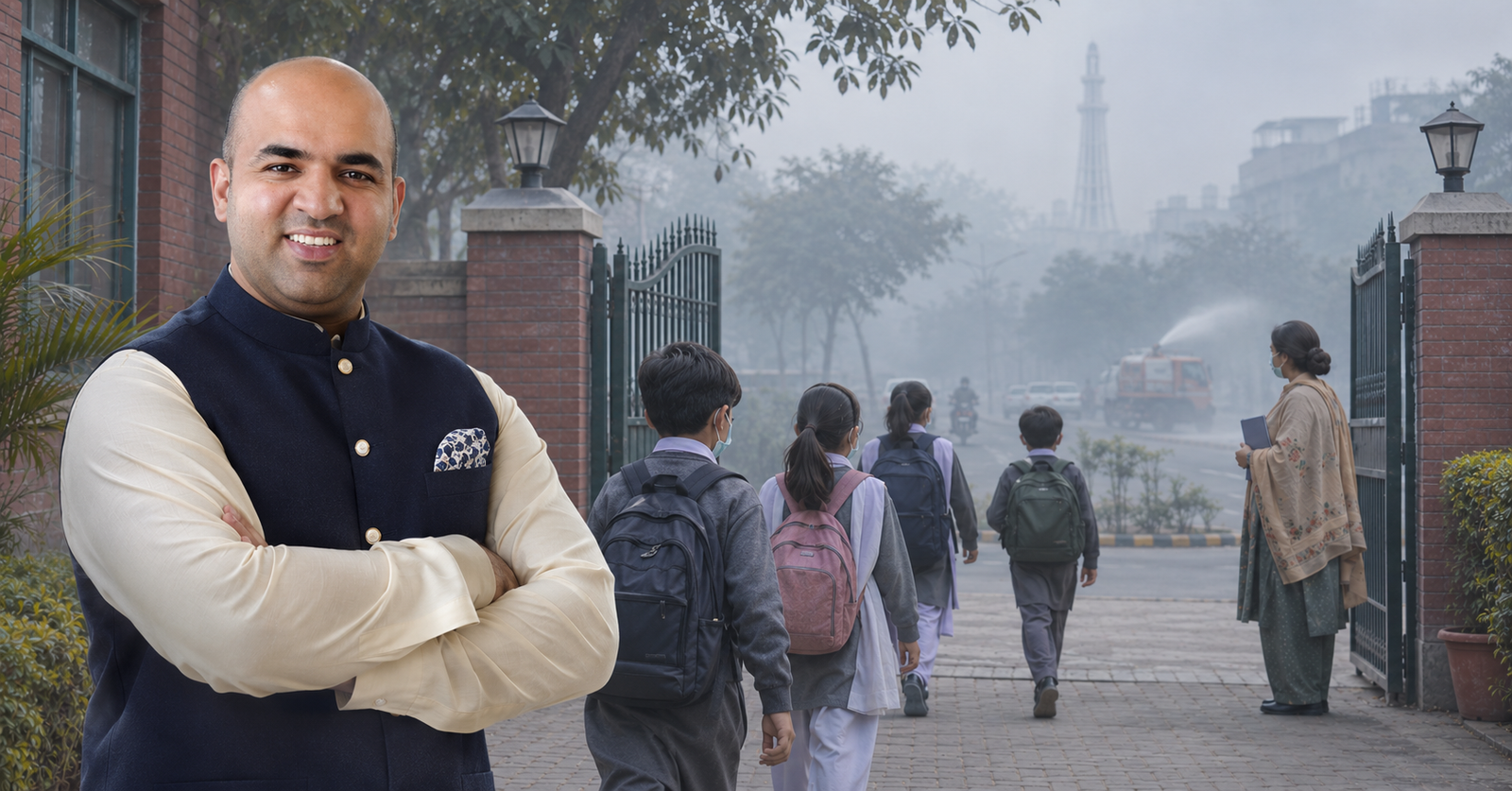
LAHORE, November 12, 2026: Punjab Education Minister Rana Sikandar Hayat has ruled out additional school holidays because of smog, saying no such decision is under consideration and educational activities will continue as usual.
The minister dismissed social media reports suggesting impending closures and urged parents to rely on official announcements instead of circulating rumours. His clarification was reported on November 11, amid continuing concerns about children’s exposure to polluted air during the winter smog season.
In the statement, Hayat also urged students to wear masks, follow government precautions and conduct outdoor activities in accordance with applicable standard operating procedures.
The announcement establishes the government’s current position on school operations; it does not amount to a declaration that air quality is safe.
Pollution Concerns Extend Beyond Lahore
The scale of the pollution problem was illustrated earlier this week when the Pakistan Cricket Board moved the second Pakistan–Sri Lanka Test from Lahore to Rawalpindi. An Associated Press report published on November 10 cited Punjab EPA data showing Lahore’s AQI had reached 421, described as hazardous. That figure relates to the reported episode and should not be treated as a live reading for November 12.
The Pakistan Meteorological Department’s forecast issued on November 11 identified the possibility of morning fog or smog at isolated locations in Lahore, Narowal, Sialkot, Gujranwala, Faisalabad, Multan, Kot Addu and Bahawalpur, as well as surrounding areas.
For November 12, the department also forecast rain, wind and thunderstorms across several northern and central Punjab districts during the evening or night, with isolated hailstorms possible. These were forecasts, rather than confirmation that rain had occurred or pollution had cleared.
Why Fog and Smog Are Different
Fog consists of tiny water droplets suspended near the ground, reducing visibility. The World Meteorological Organization distinguishes fog from mist when visibility falls below one kilometre. Smog involves air pollution and can occur alongside fog, making a hazy morning both a visibility problem and a health concern.
Weather helps determine how long pollution remains concentrated. Light winds and temperature inversions can prevent polluted air from dispersing, while rain can remove some pollutants from the atmosphere. Any improvement associated with changing weather, however, does not demonstrate that the sources of emissions have been eliminated.
ICIMOD identifies transport, industry, household fuel use and dust among Punjab’s pollution sources. It says stagnant winter conditions trap pollutants close to the ground, contributing to recurring episodes of persistent haze.
Government Targets Factories, Vehicles and Road Dust
Punjab’s current response includes enforcement against industrial emissions and smoke-emitting vehicles, alongside measures to suppress road dust.
According to a November 11 report in The Express Tribune, environment officials said more than 30 factories involved in burning tyres had been closed and fines imposed. Transport authorities and traffic police were also conducting checks against excessively smoky vehicles at Lahore’s entry points.
WASA, the Lahore Waste Management Company and the Environment Protection Department were using road washing and smog guns as part of the response.
Officials quoted in the report said no proposal had been submitted for closing educational institutions or restricting market hours. The department also claimed October smog levels were 33 per cent lower than a year earlier. That is an attributed departmental comparison, rather than evidence that every location or day experienced safe air.
Punjab’s notified Pre-Smog Action Plan 2026 also assigns drone-based monitoring a role in identifying pollution-causing activities and coordinating corrective action with field teams. EPA Punjab describes its Hawk Eye Squad as using vehicles with live cameras and thermal drones to extend surveillance beyond daylight hours.
Monitoring Expands, but Forecasts Are Not Measurements
Punjab and ICIMOD announced an upgraded air-quality dashboard in September 2026. The platform combines ground observations, satellite information, atmospheric modelling and analytical tools to identify pollution hotspots and track changing conditions.
It provides information on pollutants including PM2.5 and PM10 and incorporates a 72-hour PM2.5 forecast powered by NASA’s Goddard Earth Observing System. Such forecasts can support preventive action, but predicted pollution levels should be distinguished from readings recorded by monitoring stations.
Long-Term Programme Targets Transport and Crop Burning
Beyond seasonal enforcement, the World Bank approved a $300 million concessional loan in March 2025 for the Punjab Clean Air Program.
The programme supports a target of reducing PM2.5 levels by 35 per cent over a decade for Lahore Division. Its announced interventions include 5,000 super seeders to reduce crop-residue burning, 600 electric buses, expanded regulatory-grade monitoring and two fuel-testing laboratories.
These figures describe programme interventions and targets; they should not be read as confirmation that every vehicle, machine or laboratory has already been delivered. Punjab’s programme website lists its implementation period as April 2025 to June 2030.
Cross-Border Pollution Adds a Regional Dimension
Punjab’s government has also blamed pollution drifting from India, including emissions associated with Diwali fireworks, for worsening conditions this week, Reuters reported on November 10. This remains an attributed explanation for the episode, alongside the documented contribution of domestic emissions and unfavourable weather.
School Attendance and Children’s Health Remain Separate Questions
The World Health Organization identifies air pollution as a major environmental risk to children’s health. Exposure to particulate pollution is associated with respiratory and cardiovascular disease, underscoring why keeping schools operational does not remove the need to manage exposure.
For parents, the immediate administrative position is that additional smog holidays have not been announced. The minister has asked families to follow official updates and protective instructions.
For the provincial government, the continuing challenge is to translate monitoring, enforcement and planned investments into sustained reductions in emissions, while ensuring that school operations remain responsive to changing environmental conditions.