


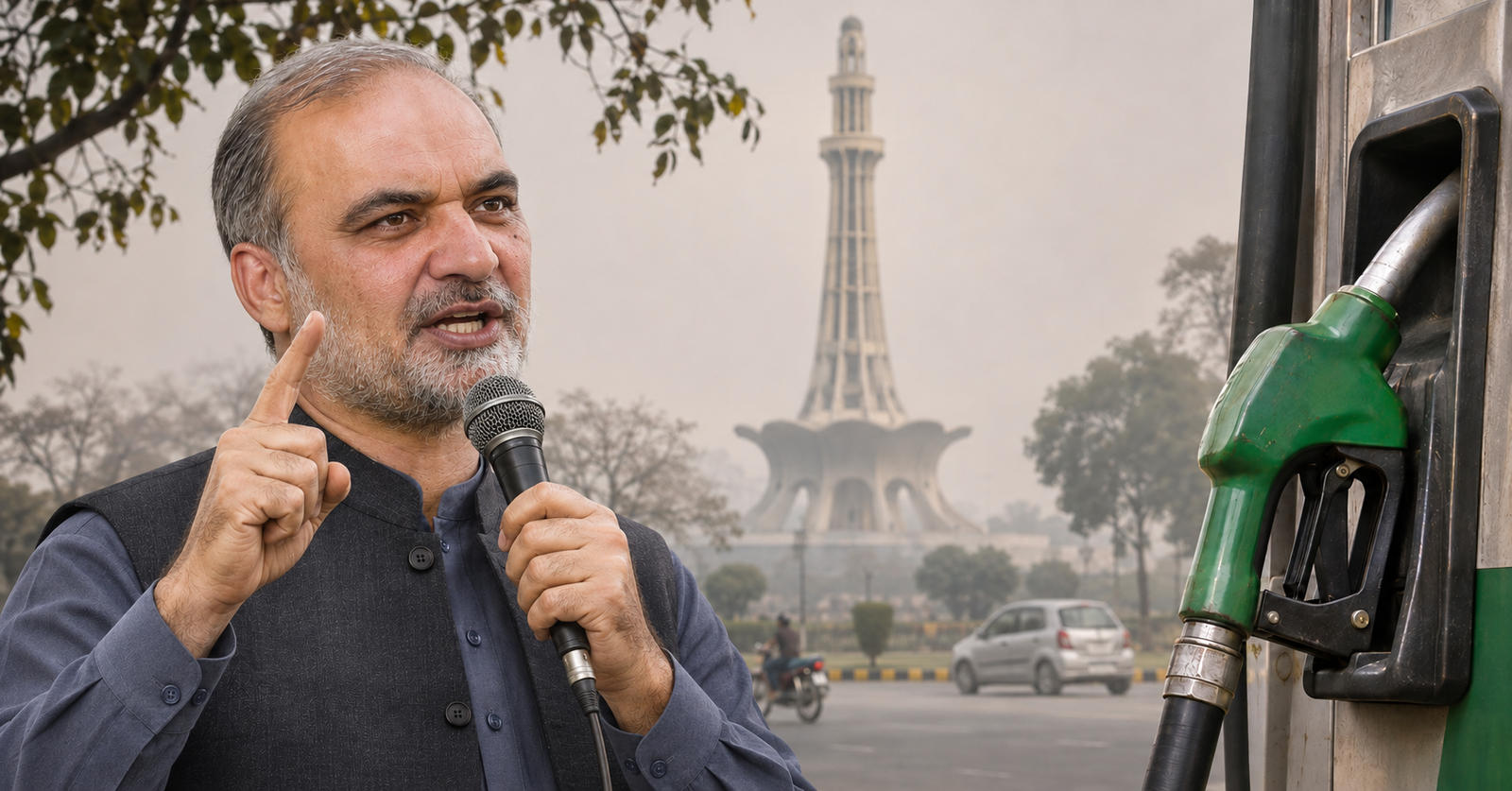
LAHORE, November 12, 2026: Jamaat-e-Islami chief Hafiz Naeemur Rehman has announced a public rally at Minar-e-Pakistan on November 29, saying the party has not abandoned its campaign against the petroleum levy and will continue negotiations alongside street protests.
Addressing a press conference at Mansoorah, he announced another gathering in Quetta on November 22, followed by rallies in Khyber Pakhtunkhwa and Karachi. He maintained that the party’s demand remained the abolition of the levy, rather than temporary reductions in pump prices.
The announcement comes as the government has introduced further fuel-price reductions. Petrol was reduced by Rs3 to Rs335 per litre and high-speed diesel by Rs7 to Rs364 per litre for November 12. The latest movement is therefore downward, even as the political argument continues over why fuel remains expensive and how much consumers should contribute through levies and duties.
JI Demands Wider Relief and Taxes on Larger Vehicles
Hafiz Naeem said approximately nine to ten rounds of negotiations had taken place and that JI had submitted technical proposals. According to his account, the government had indicated it would consider a gradual reduction in the levy.
He demanded that the fuel-relief scheme be expanded from cars up to 800cc to vehicles up to 1,300cc, arguing that salaried and middle-class families also use these cars. He sought support for tractors and public transport and proposed restricting public officials to vehicles no larger than 1,300cc.
As an alternative source of revenue, he called for higher import duties and a greater levy burden on vehicles above 1,800cc. These remain JI proposals, rather than announced government policy.
In the City42 account of his remarks, Hafiz Naeem said the government had told the party that 15 million people were receiving relief. He also claimed JI’s pressure had forced concessions and challenged what he described as an earlier indication that petrol could reach Rs1,000 per litre. That projected figure should be understood as part of his account of the dispute, not an established price forecast.
He accused influential interests in oil refining, sugar, flour, gas and independent power production of benefiting at consumers’ expense, alleging that these interests crossed government and opposition lines. Those are political allegations; the press conference itself does not establish unlawful collusion.
How the Protest Campaign Reached This Point
JI’s latest rally announcements follow sit-ins launched on August 16 and a nationwide strike on September 3. The party subsequently postponed its planned Islamabad “Super Long March” on September 22 after a request for negotiations from Prime Minister Shehbaz Sharif.
Associated Press reporting in October also linked the introduction of targeted fuel assistance to the period in which JI was threatening a march on Islamabad. This supports the political context of the negotiations, but does not establish that the party alone caused subsequent price reductions.
What Relief Has the Government Actually Approved?
The Economic Coordination Committee approved the Prime Minister’s Fuel Relief Scheme on September 14.
Under the announced design, eligible two- and three-wheelers receive Rs500 per week, described as the equivalent of a Rs100-per-litre concession on five litres. Cars up to 800cc receive Rs1,000 for ten days, based on 30 litres per month at the same concession.
The approval restricted eligibility to non-commercial users and one vehicle per owner, with delivery through a digital Fuel Pass System. JI’s demand for tractors, public transport and larger cars would therefore require changes to the approved coverage.
Why Fuel Became Expensive—and Why It Is Now Falling
International supply risks are one part of the explanation. Conflict involving Iran and disruption risks around the Strait of Hormuz have affected oil markets and shipping. Importing countries face the cost of the product, transport and associated risks before domestic taxes are added.
However, international prices have recently retreated. Reuters reported that Brent settled at $92.57 a barrel on November 9, down 5.85 per cent that day, as expectations of restraint over Iran encouraged selling. Brent had also fallen sharply during the preceding week.
Pakistan’s pricing mechanism also helps explain why an international fall does not appear immediately or identically at the pump. The November 12 pricing sheet uses seven-working-day averages for international benchmarks and the exchange rate. Petrol calculations refer to the price of finished gasoline, with freight and premiums added; a headline Brent crude quotation is therefore not the complete cost of imported petrol.
The rupee-dollar rate matters because international fuel costs are denominated in dollars. A weaker rupee raises the local-currency cost of the same import, while a stronger rupee can provide relief. This is a pricing mechanism, not evidence that rupee depreciation caused the latest revision.
Domestic duties, levies, distribution costs and regulated margins then add to the price. Consequently, falling international oil prices and persistently expensive retail fuel can occur at the same time.
The Levy Has Not Disappeared
The Petroleum Division’s notification effective October 31 retained an overall petroleum levy of Rs80 per litre on ordinary petrol and high-speed diesel, alongside a Rs5 climate support levy.
For petrol, it introduced a split between the amount charged through oil marketing companies and a contribution paid by refineries. This distinction matters: transferring part of the burden to refineries is different from abolishing the levy.
The November 12 price build-up, available in a reproduced pricing sheet, records the following petrol components:
| Component | Rupees per litre |
|---|---|
| Ex-refinery/import price, including customs duty | 240.65 |
| Inland freight equalisation margin | 8.17 |
| Oil marketing company margin | 7.87 |
| Dealer margin | 9.98 |
| Petroleum levy charged directly after refinery adjustment | 63.64 |
| Climate support levy | 5.00 |
| Sales tax | 0.00 |
| Rounding adjustment | −0.31 |
| Notified price, excluding secondary freight | 335.00 |
The sheet records a gross petroleum levy of Rs80, offset by a Rs16.36 refinery adjustment in the consumer-price calculation. It also identifies Rs25.94 in customs duty within the ex-refinery/import price. These components should not be counted twice when calculating the government-charge portion.
Why the Government Cites the IMF
The dispute also concerns a substantial budget revenue stream. Pakistan’s 2026–27 federal budget projects petroleum-levy receipts of approximately Rs1.677 trillion, classified as non-tax revenue. Abolition would therefore require replacement revenue, spending reductions or a revised fiscal framework.
In its October 7 statement, the IMF called for implementation of the budget and recommended promptly phasing out the fuel-support scheme because of its cost and broad targeting. It said any future assistance should be limited, temporary, delivered through established social-assistance programmes and accommodated within the budget.
The IMF position therefore concerns fiscal sustainability and the design of support. Domestic authorities still determine the notified fuel charges; saying that the IMF directly sets every pump price would misrepresent that process.
How Pakistan Compares with Other Countries
The following comparison uses US dollars per litre to avoid comparing different national currencies as if they had equal value.
Pakistan’s entry uses the November 12 notified ordinary-petrol price, converted at the Rs276.82-per-dollar rate used in that day’s pricing sheet. Other entries are from GlobalPetrolPrices’ November 9 regional update.
| Country | Petrol price, approximately US$/litre | Reference date |
|---|---|---|
| Saudi Arabia | 0.62 | November 9, 2026 |
| United Arab Emirates | 1.10 | November 9, 2026 |
| India | 1.16 | November 9, 2026 |
| Pakistan | 1.21 | November 12, 2026 |
| Bangladesh | 1.33 | November 9, 2026 |
| Nepal | 1.33 | November 9, 2026 |
| Sri Lanka | 1.48 | November 9, 2026 |
Sources: GlobalPetrolPrices regional series and calculation from Pakistan’s November 12 pricing sheet. Figures are rounded.
This is an indicative comparison, not an exact same-day, same-grade ranking. GlobalPetrolPrices generally reports a 95-octane series, while Pakistan’s ordinary-petrol pricing sheet references 92 RON gasoline. Taxes, fuel grades, subsidy eligibility and local retail prices also differ.
On these figures, Pakistan is more expensive than India and the two Gulf countries shown, but cheaper than Bangladesh, Nepal and Sri Lanka. That does not establish affordability: the burden on a household depends on income, commuting requirements and access to public transport, as well as the price per litre.
Can Higher Taxes on Luxury Vehicles Replace the Levy?
JI’s proposal would shift more of the burden towards larger-vehicle owners. Its fiscal adequacy, however, remains unproven in the material reviewed.
An import duty is collected when a vehicle enters the country, while the petroleum levy generates revenue repeatedly as fuel is sold. Replacing a levy with a budget target approaching Rs1.7 trillion would require a published estimate of taxable vehicles, import volumes, likely changes in purchasing behaviour and the revenue each proposed measure would generate.
For now, three separate developments define the dispute: fuel prices have recently fallen, targeted assistance is operating under an approved scheme, and JI continues to demand a broader change in who pays for fuel taxation. The November 29 Lahore rally is intended to maintain pressure while those negotiations continue.