


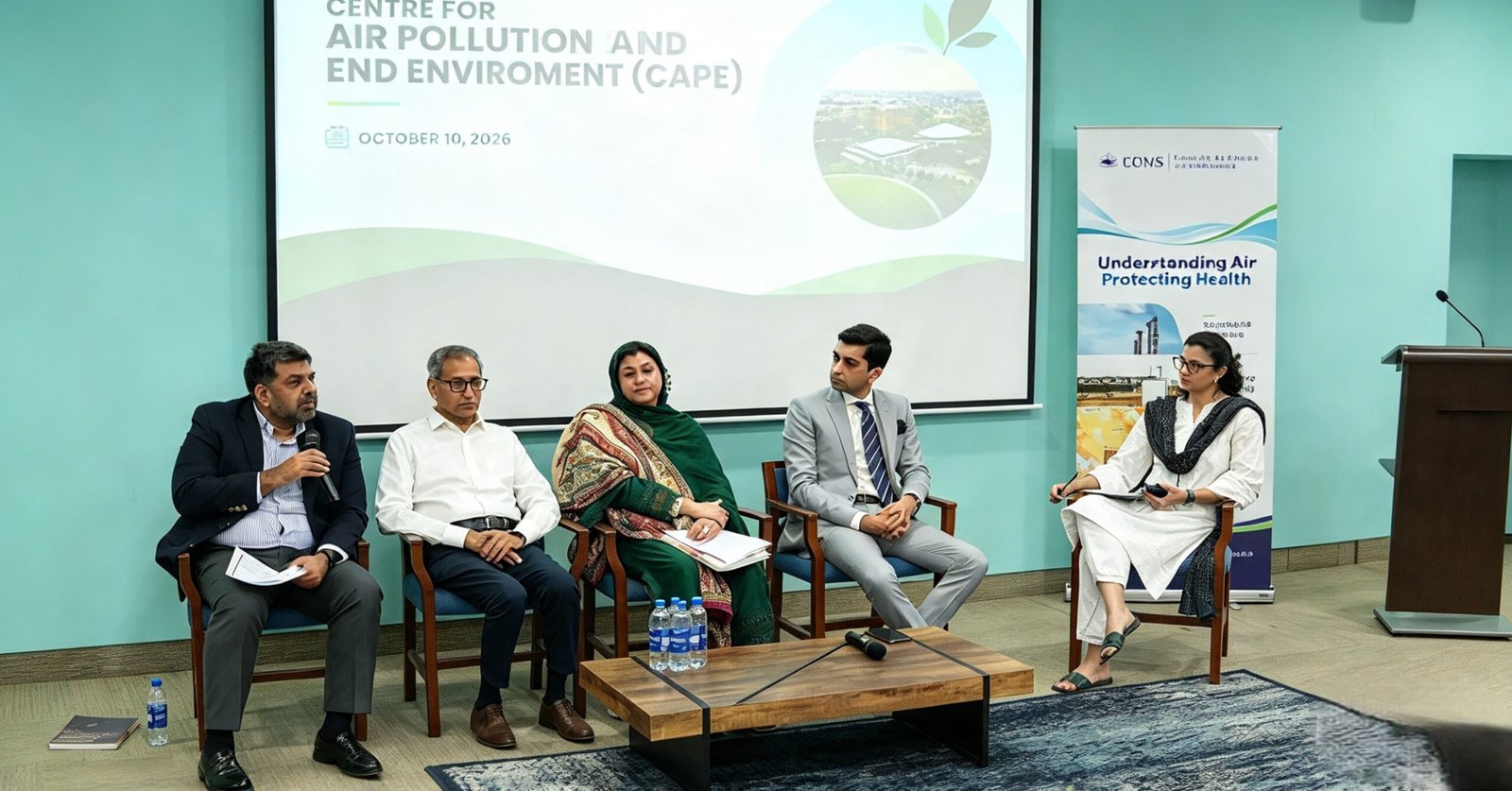
LAHORE: The Lahore University of Management Sciences (LUMS) has established the Centre for Air Pollution and Environment (CAPE) to investigate the causes and spread of air pollution across Punjab.
Supported financially by Coefficient Giving, the centre will conduct a multi-year research study to identify major sources of air pollution and determine how much each contributes to deteriorating air quality. The initiative also includes the establishment of an advanced laboratory for the chemical analysis of air pollution samples collected from different locations across the province.
LUMS Establishes Centre for Air Pollution Research
Dr Qasim Imtiaz, a faculty member in the Department of Chemistry and Chemical Engineering at LUMS, has been appointed the founding director of CAPE. The research team also includes Dr Farah Saeed, Dr Shahana Khurshid and Dr Walter Schwarzacher.
The centre was inaugurated at a ceremony attended by LUMS leadership, members of its policy advisory board, provincial government departments, air quality organisations, researchers and development partners. Participants discussed Punjab’s air pollution challenges and the need for scientific evidence to develop effective solutions.
Addressing the ceremony, LUMS Provost Dr Tariq Mahmood Jadoon highlighted the centre’s objectives and the importance of scientific research in tackling air pollution. Dr Walter Schwarzacher, Dean of the Syed Babar Ali School of Science and Engineering, also spoke about the establishment of the centre.
Explaining the research initiative, Dr Qasim Imtiaz said reliable data was essential to determine the contribution of different sources to air pollution. He said CAPE would generate scientific evidence and work with government authorities, researchers and local communities to develop targeted measures aimed at protecting public health.
The centre’s research will focus on identifying pollution sources, assessing their effects, examining indoor air quality in schools and strengthening links between scientific research, local communities and policymakers. Chemical analysis of samples collected from across Punjab will help researchers understand the contribution of different sources to the province’s air pollution problem.
Experts and Government Officials Discuss Smog Control
A session chaired by Dr Shahana Khurshid featured representatives from the Punjab Environment Protection and Climate Change Department, the Urban Unit and the Pakistan Air Quality Initiative. Participants discussed smog reduction measures, air quality monitoring, emissions data from different sectors, air quality action plans and public awareness initiatives.
The session also reviewed existing air quality data and monitoring efforts in Punjab, highlighting areas where further research is needed to better understand pollution levels and develop effective interventions. American Business Forum President Usman Khalid Waheed presented honorary shields to the speakers at the conclusion of the session.
Another discussion, chaired by Dr Farah Saeed, brought together Muhammad Hassan Ahsan, Secretary of the Punjab Transport and Mass Transit Department and a representative of the Provincial Transport Authority; Muhammad Ahsan Younas, Managing Director of the Punjab Safe Cities Authority; Zahida Azhar, Additional Secretary (Universities) at the Punjab Higher Education Department; and Dr Muhammad Zaman, Professor at the School of Sociology at Quaid-i-Azam University.
The participants discussed research gaps, pollution control strategies and the importance of reliable data in assessing the effectiveness of environmental interventions. Speakers emphasised the need for evidence-based policymaking and stronger coordination among government departments, researchers and other stakeholders to address the province’s air pollution challenges.
LUMS Rector Shahid Hussain concluded the ceremony by thanking the speakers, participants and partners for their contributions to the establishment of the centre.
Air Pollution Research Aims to Protect Public Health
Air pollution remains a major environmental and public health challenge in Pakistan. Estimates cited in the information provided for the initiative suggest that average life expectancy could increase by approximately 2.6 years in Karachi, 4.6 years in Islamabad and 5.3 years in Lahore if outdoor air pollution were reduced to meet international health guidelines.
The establishment of CAPE is intended to strengthen the scientific evidence available to policymakers and support more targeted efforts to improve air quality and protect public health across Punjab.